EU Customs & IOSS 2025: Complete Guide to €150 Threshold Changes & Import Compliance

Noel Murphy
Logistics Expert & Ecommerce Consultant
2025-11-15
Navigate EU customs with our complete IOSS guide. Learn about the €150 threshold removal (2026-2028), ICS2 requirements, EORI numbers, and how to avoid costly VAT penalties when shipping from China.
Let me tell you something that catches most China-based sellers completely off guard: EU customs compliance in 2025 is more complex than ever, and it's about to get even trickier. The €150 customs duty exemption that made low-value shipping affordable? It's being removed (2026-2028 implementation). The IOSS scheme everyone thought was "optional"? It's now essential for avoiding 25% delivery refusals. And don't even get me started on ICS2 Entry Summary Declarations—get this wrong and your shipment is refused at the border.
After helping thousands of sellers navigate EU customs through our Shenzhen facility, I can tell you this: the sellers who succeed in the EU market are the ones who understand IOSS, EORI numbers, and the shifting regulatory landscape. The ones who fail? They're still treating the EU like it's 2020. In this comprehensive guide, I'm going to show you exactly what's changed, what's coming, and how to stay compliant whilst keeping your margins intact.
🇪🇺 Critical EU Customs Changes: 2025-2028 Timeline
✅ Already In Effect (2024-2025)
- • IOSS scheme operational (voluntary)
- • ICS2 Release 3 mandatory (ENS declarations)
- • €150 threshold still active (no customs duty)
- • VAT collection at checkout preferred
- • EORI numbers required for all imports
⚠️ Coming Soon (2026-2028)
- • €150 threshold removal (customs duty on ALL imports)
- • ViDA directive (VAT in Digital Age, 2028)
- • Platform liability for VAT collection
- • Enhanced customs data requirements
- • Stricter penalty enforcement (€5,000+ fines)
Section 1: Understanding IOSS (Import One-Stop Shop)
IOSS was introduced on July 1, 2021, to simplify VAT collection on low-value goods (€150 or less) imported into the EU. Instead of customers paying VAT at delivery (plus handling fees), sellers collect VAT at checkout and remit it monthly. Here's why this matters:
🎯 The Customer Experience Problem
❌ Without IOSS (DDU Shipping)
- • Customer orders €50 product
- • Package arrives at customs
- • Postal service charges €10 VAT + €12 handling
- • Customer receives €22 surprise bill
- • Result: 25% refuse delivery
✅ With IOSS (DDP Shipping)
- • Customer sees €60 total at checkout (€50 + €10 VAT)
- • Package clears customs instantly (IOSS number on label)
- • No handling fees, no surprise bills
- • Customer receives package hassle-free
- • Result: 2-3% refusal rate
💡 IOSS increases conversion by 8-12% and reduces customer complaints by 70%
How IOSS Works: The Technical Flow
- 1. Registration: Non-EU sellers register via an EU intermediary (cannot register directly). Receive 12-digit IOSS number starting with "IM" (e.g., IM2760000742).
- 2. Checkout Integration: Calculate correct VAT rate based on customer's country and product type. Display VAT separately: "Product: €50 + VAT (21%): €10.50 = Total: €60.50"
- 3. Shipping Label: Include IOSS number prominently on commercial invoice and shipping label. Format: "IOSS: IM2760000742"
- 4. Customs Clearance: EU customs sees IOSS number → verifies VAT paid → clears instantly (no inspection, no handling fees)
- 5. Monthly Remittance: By the end of each month, your intermediary files IOSS return with total VAT collected. You pay intermediary (they remit to EU tax authorities), typically 3-5% commission on GMV
IOSS Registration: Non-EU Sellers Need Intermediaries
This is where it gets tricky. China-based sellers cannot register for IOSS directly with EU tax authorities. You need an EU intermediary (also called "deemed supplier" or "IOSS representative"). Here's how it works:
🏢 IOSS Intermediary Services
What they provide:
- • IOSS number registered in their name (you use it)
- • Monthly VAT return filing to EU authorities
- • VAT remittance on your behalf
- • Compliance with EU VAT regulations
- • Legal representation in case of audits
What you pay:
- • Commission: 3-5% of GMV (gross merchandise value)
- • Setup fee: €200-500 (one-time)
- • Monthly minimum: Some require €500-1,000 minimum GMV
💡 Alternative: EU Fulfillment Partner with IOSS
Many EU-based fulfillment centres offer IOSS registration as part of their service. If you're using an EU warehouse for inventory, they often provide IOSS at no extra cost (included in fulfillment fees). This is simpler than managing a separate intermediary relationship.
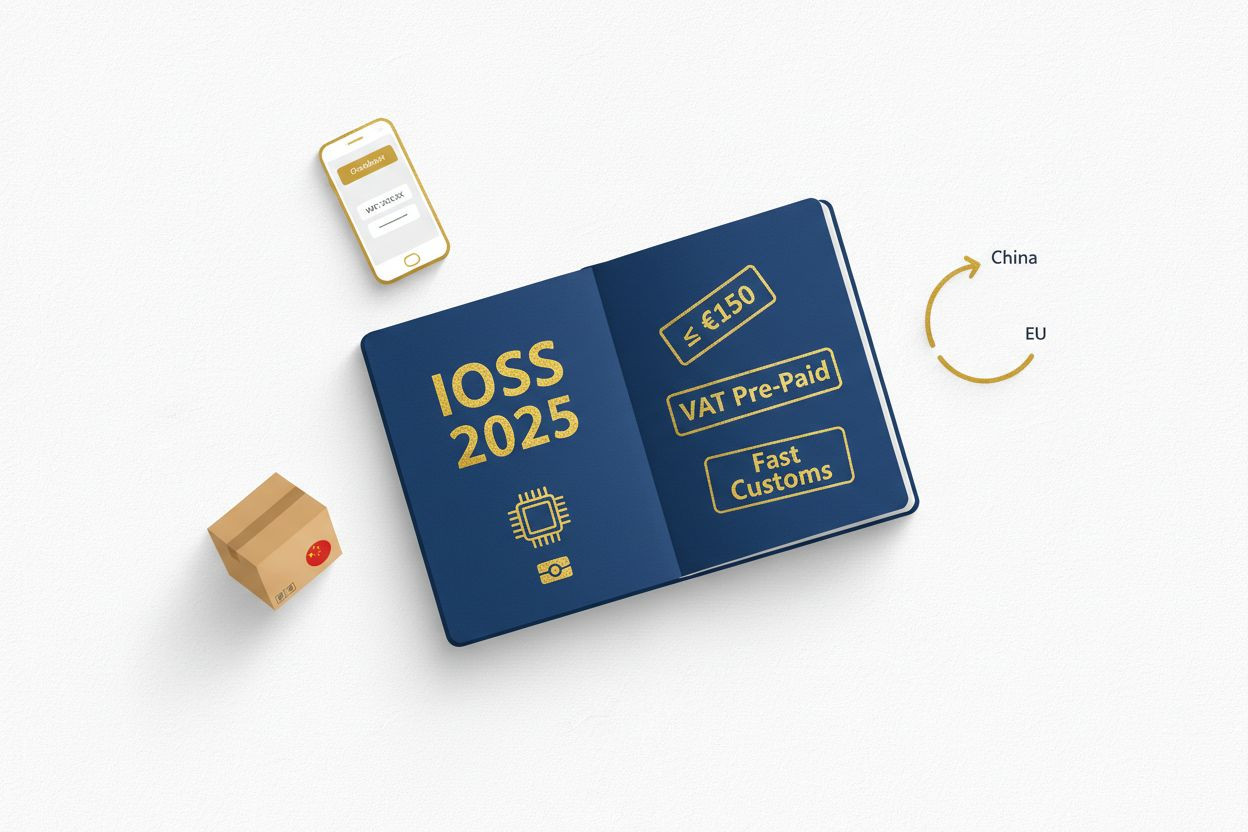
IOSS acts as your VAT passport for smooth EU customs clearance
Section 2: The €150 Threshold Removal (2026-2028)
In November 2025, the EU formally agreed to remove the €150 customs duty exemption, specifically targeting Chinese e-commerce platforms like Temu, Shein, and AliExpress. This is a massive change with serious cost implications. Here's what's happening:
Current System (Until 2026-2028)
✅ Current Rules (2025)
- • Goods ≤€150: NO customs duty (0%), but VAT still applies (17-27%)
- • Goods >€150: Customs duty (typically 4-17% based on HS code) + VAT
- • Example: €100 t-shirt from China pays €21 VAT (21% NL rate), but €0 customs duty
New System (After Threshold Removal)
⚠️ After €150 Removal (2026-2028)
- • ALL imports: Customs duty applies (no exemption threshold)
- • Typical duty rates: Textiles 12%, Electronics 4-14%, Toys 4.7%, Shoes 8-17%
- • Example: Same €100 t-shirt now pays €21 VAT + €12 customs duty = €33 total (33% increase)
- • IOSS still works: IOSS continues for VAT collection, but customs duty paid separately
Financial Impact Calculator
💰 Cost Comparison: Before vs After Threshold Removal
Example 1: €50 T-Shirt (Textiles, 12% duty)
Current (2025):
- Product: €50
- Customs Duty: €0 (exempt)
- VAT (21%): €10.50
- Total: €60.50
After Removal (2027):
- Product: €50
- Customs Duty (12%): €6
- VAT (21%): €11.76
- Total: €67.76
⚠️ Price increase: €7.26 (12% markup)
Example 2: €100 Wireless Headphones (Electronics, 8% duty)
Current (2025):
- Product: €100
- Customs Duty: €0 (exempt)
- VAT (19%): €19
- Total: €119
After Removal (2027):
- Product: €100
- Customs Duty (8%): €8
- VAT (19%): €20.52
- Total: €128.52
⚠️ Price increase: €9.52 (8% markup)
📊 Strategic Response to Threshold Removal
- 1. Adjust pricing now: Start building customs duty (8-15%) into your pricing to avoid sudden price jumps in 2027
- 2. Optimize product mix: Focus on products with lower duty rates (electronics 4-8% vs textiles 12%)
- 3. Consider EU warehousing: Goods already in EU avoid import duties entirely (pay once on bulk import)
- 4. Transparent communication: Explain to customers that price increases are due to EU regulatory changes, not your markup
Section 3: ICS2 Entry Summary Declarations (Mandatory Since March 2024)
ICS2 (Import Control System 2) is the EU's new pre-arrival cargo security system. Release 3 went live in March 2024, and it's causing major headaches for sellers who don't understand the requirements. Here's what you need to know:
What is an Entry Summary Declaration (ENS)?
An ENS is a detailed safety and security declaration submitted BEFORE cargo arrives at the EU border. It includes:
- • Shipper details: Full name, address, EORI number
- • Consignee details: Full name, address, EORI number (if commercial)
- • Product information: HS codes, quantities, weights, descriptions
- • Transport details: Flight/vessel number, arrival port, routing
- • Value declaration: CIF value in euros
ICS2 Timeline and Submission Deadlines
| Transport Mode | Submission Deadline | Implementation Date |
|---|---|---|
| Air Freight (Express) | 4 hours before arrival | ✅ Active (March 2024) |
| Sea Freight (FCL/LCL) | 24 hours before loading | ✅ Active (March 2023) |
| Road Transport | 1 hour before arrival | ⚠️ Phased (Apr-Sept 2025) |
| Rail Transport | 2 hours before arrival | ⚠️ Phased (Apr-Sept 2025) |
🚨 Non-Compliance Consequences
- • Shipment refused entry: Cargo cannot enter EU without valid ENS
- • Detention at border: Goods held whilst ENS is submitted (days/weeks delay)
- • Storage fees: €50-200/day whilst cargo sits at port/airport
- • Fines: €1,000-5,000 per violation for repeated non-compliance
- • Carrier penalties: Airlines/shipping lines face fines, may refuse future bookings
Who Submits ENS? (It's Usually Your Carrier)
For most sellers, you don't submit ENS directly—your carrier or freight forwarder handles it. But you must provide accurate data:
✅ Express Carriers (DHL, FedEx, UPS)
- • They handle ENS: Automated submission as part of their process
- • You provide: Accurate commercial invoice with HS codes, EORI numbers, product descriptions
- • Cost: Included in shipping rate (no extra charge)
- • Risk: Low (they're experts at compliance)
⚠️ Freight Forwarders / Air Freight
- • They submit ENS: But rely on your data accuracy
- • You provide: Complete master air waybill (MAWB) data, packing lists, detailed invoices
- • Cost: Sometimes extra €20-50 "ENS filing fee"
- • Risk: Medium (errors common if data incomplete)
Confused by EU Compliance? We Handle It All
PFC Express manages IOSS registration, ICS2 declarations, EORI numbers, and customs documentation so you can focus on selling.
Get Free EU Compliance ConsultationSection 4: EORI Numbers (Economic Operator Registration)
Every business that imports into or exports from the EU needs an EORI number. Think of it as your customs ID—without it, your goods won't clear customs. Here's the breakdown:
What is an EORI Number?
- • Format: 2-letter country code + up to 15 digits (e.g., DE123456789012345)
- • Unique identifier: One EORI per business, valid across all 27 EU countries
- • Purpose: Track all import/export activities for tax and security purposes
- • Cost: Free (application and maintenance)
- • Validity: Permanent (unless company dissolves or registration cancelled)
Who Needs an EORI Number?
✅ You NEED an EORI if:
- • You're importing commercial goods into the EU (for resale)
- • You're exporting goods from the EU
- • You're using customs procedures (transit, warehousing, etc.)
- • You're acting as importer of record
⚠️ You MIGHT NOT need EORI if:
- • Receiving personal gifts (non-commercial, under €45)
- • Using express carriers with their EORI (they act as importer temporarily)
- • Working with EU fulfillment partner who imports on your behalf (they use their EORI)
How to Apply for an EORI Number
Step-by-Step Process (Example: Germany EORI)
- 1. Choose your "gateway" country: Apply in the first EU country you ship to (e.g., Germany if you primarily ship to Germany)
- 2. Gather required documents:
- • Business registration certificate (China company registration)
- • Proof of trade activity (invoices, purchase orders)
- • Passport/ID of legal representative
- • EU VAT number (if you have one, not always required)
- 3. Submit online application: Visit national customs website (e.g., German Zoll portal:
www.zoll.de), complete EORI application form - 4. Processing time: 3-10 business days (Germany typically 5 days, Netherlands 7-10 days)
- 5. Receive EORI: Emailed directly, also searchable in EU EORI validation database
💡 Pro Tip: Multiple EORIs for Multiple Countries?
You only need ONE EORI number for the entire EU. However, you must apply in the country where you're established or where you first operate. If you're a China-based seller with no EU presence, apply in the country you ship to most frequently.
Example: If 60% of your shipments go to Germany, apply for a DE EORI. It will work for shipments to France, Italy, Spain, etc.
DDP delivery with IOSS ensures customers receive packages with VAT pre-paid and no surprise fees
Section 5: Country-Specific VAT Rates
VAT rates vary significantly across the 27 EU member states. Knowing these rates is essential for accurate pricing and IOSS calculations:
| Country | Standard VAT Rate | Reduced Rates | Notes |
|---|---|---|---|
| 🇩🇪 Germany | 19% | 7% (books, food) | Large market, 19% most common |
| 🇫🇷 France | 20% | 5.5%, 10% | Strict compliance enforcement |
| 🇳🇱 Netherlands | 21% | 9% (food, medicine) | High VAT, popular hub |
| 🇪🇸 Spain | 21% | 10%, 4% | Canary Islands exempt |
| 🇮🇹 Italy | 22% | 10%, 5%, 4% | Complex reduced rate system |
| 🇵🇱 Poland | 23% | 8%, 5% | Growing market |
| 🇮🇪 Ireland | 23% | 13.5%, 9% | English-speaking, high VAT |
| 🇸🇪 Sweden | 25% | 12%, 6% | Highest standard rate |
| 🇩🇰 Denmark | 25% | None | No reduced rates |
| 🇭🇺 Hungary | 27% | 18%, 5% | Highest VAT in EU |
💡 Pricing Strategy for Multi-Country Sales
Most Shopify/WooCommerce stores calculate VAT dynamically based on customer location. Best practice:
- • Display prices excluding VAT ("€50 + VAT")
- • Calculate VAT at checkout based on shipping country
- • Show total clearly: "€50 + €10.50 VAT (21%) = €60.50"
- • Use tax automation plugins (Avalara, TaxJar, Quaderno) to handle multi-country VAT
Section 6: Real-World Compliance Workflow
Let's walk through an actual shipment from China to Germany to show how all these pieces fit together:
📦 Complete Workflow: €80 Wireless Headphones to Berlin
Step 1: Customer Places Order (Shopify Store)
- • Customer location detected: Germany
- • Product price: €80
- • VAT calculated: €15.20 (19% German rate)
- • Shipping: €8 (DHL Express)
- • Total charged: €103.20
Step 2: Generate Commercial Invoice
- • Product description: "Wireless Bluetooth Headphones, Model XYZ"
- • HS Code: 8518.30.95 (headphones with wireless capability)
- • Value: €80 (product only, shipping separate)
- • IOSS Number: IM2760000742 (prominently displayed)
- • Shipper EORI: CN123456789 (your China company EORI if registered)
- • Consignee: Customer name + full Berlin address
Step 3: Ship via DHL Express (Shenzhen → Berlin)
- • DHL receives package with commercial invoice
- • DHL submits ICS2 Entry Summary Declaration (ENS) 4 hours before flight arrival
- • Flight: 12 hours (direct Shenzhen → Frankfurt hub)
- • Customs clearance: 6-12 hours (IOSS number = instant clearance)
- • Ground delivery: Frankfurt → Berlin (1 day)
Step 4: Customs Clearance Process
- • German customs scans package
- • Sees IOSS number IM2760000742
- • Checks EU IOSS database → VAT paid ✅
- • No inspection, no handling fee, no customer charge
- • Package clears in 6 hours
Step 5: Customer Receives Package (3-5 days total)
- • DHL delivers to customer's door
- • No surprise bills, no customs delays
- • Customer happy, leaves 5-star review ⭐⭐⭐⭐⭐
Step 6: Monthly IOSS Remittance
- • End of month: Your IOSS intermediary files return
- • Total VAT collected from all German sales: €1,520 (example)
- • You pay intermediary: €1,520 VAT + €76 commission (5%)
- • Intermediary remits €1,520 to German tax authorities
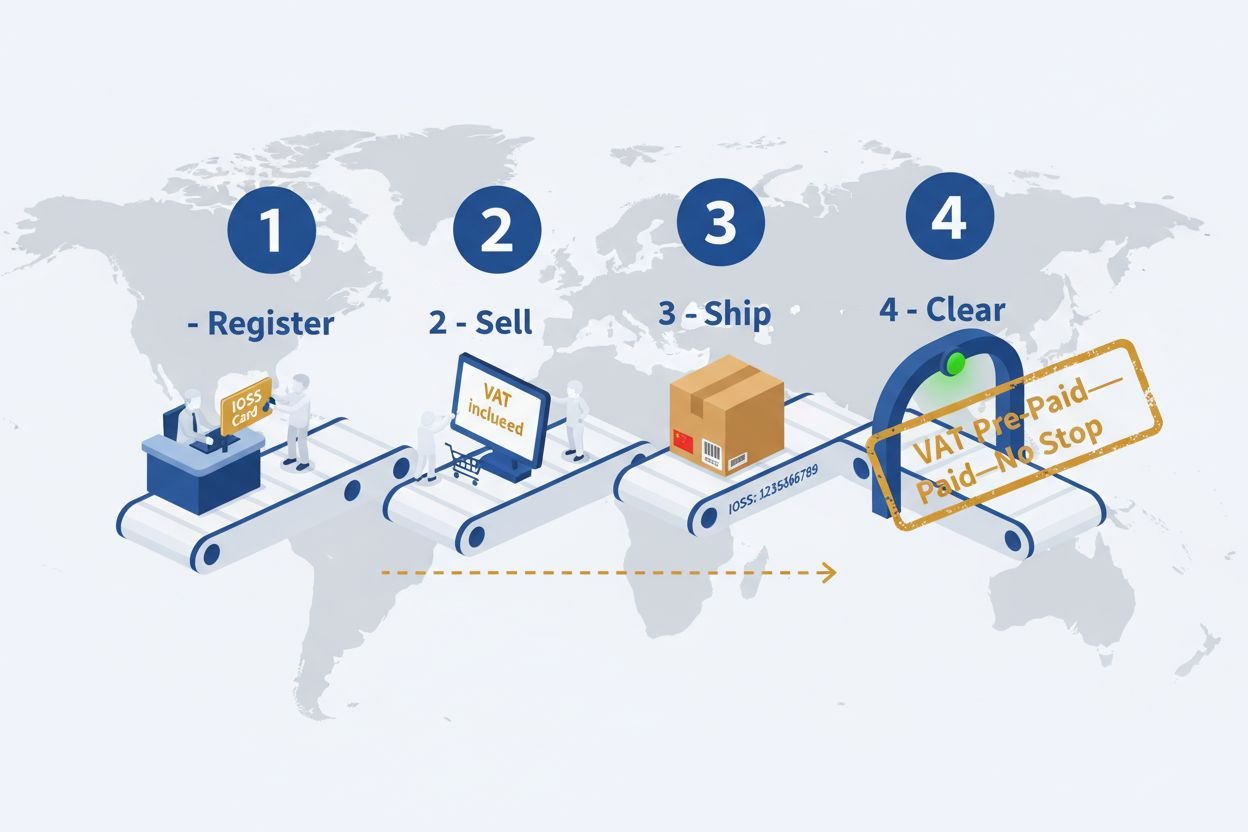
Complete IOSS import workflow from order to delivery with VAT compliance
Section 7: ViDA Directive (VAT in the Digital Age) - Coming 2028
The ViDA (VAT in the Digital Age) directive, agreed in May 2024, introduces further changes to EU VAT enforcement targeting digital platforms and e-commerce. Implementation is scheduled for July 1, 2028. Here's what's coming:
🔮 ViDA Key Changes (2028)
- • Platform liability: Marketplaces (Amazon, eBay, Etsy) become liable for VAT collection if seller doesn't comply
- • Real-time reporting: e-Invoicing mandatory for B2B transactions (machine-readable formats)
- • Single VAT registration: Simplified registration across all 27 member states
- • Enhanced data sharing: Tax authorities can access real-time sales data from platforms
- • Penalties increase: Non-compliance fines rise to €10,000-50,000 per violation
Section 8: Cost-Benefit Analysis: IOSS vs Non-IOSS
Should you use IOSS? Let's calculate the economics for a typical ecommerce seller:
💰 Monthly Cost Comparison (100 orders/month, €50 AOV)
❌ Without IOSS (DDU)
Monthly GMV: €5,000 (100 orders × €50)
VAT collected: €0 (customer pays at delivery)
Handling fees paid by customers: €12/order
Delivery refusal rate: 25% (25 orders)
Lost revenue: €1,250 (25 × €50)
Return shipping costs: €625 (25 × €25)
Customer complaints: High (poor reviews)
Total Monthly Loss: €1,875
✅ With IOSS (DDP)
Monthly GMV: €5,000 (100 orders × €50)
VAT collected: €1,000 (20% avg)
IOSS commission (5%): €250
Delivery refusal rate: 2% (2 orders)
Lost revenue: €100 (2 × €50)
Return shipping costs: €50 (2 × €25)
Customer satisfaction: High (5-star reviews)
Total Monthly Cost: €400
💡 IOSS saves €1,475/month + improves conversion by 8-12%
Section 9: Best Practices Checklist
✅ EU Compliance Checklist for China Sellers
Stop Losing Sales to VAT Surprises
PFC Express handles your IOSS registration, EORI applications, ICS2 compliance, and VAT calculations. Ship to the EU with confidence.
Get IOSS Setup in 7 DaysFinal Thoughts: EU Compliance is Your Competitive Advantage
Most China-based sellers view EU customs compliance as a headache—paperwork, fees, complexity. But here's the opportunity: 90% of your competitors are getting this wrong. They're shipping DDU without IOSS, causing customer complaints and delivery refusals. They're skipping EORI registration and facing customs delays. They're underprepared for the €150 threshold removal.
By implementing IOSS, obtaining proper EORI numbers, and preparing for regulatory changes now, you're positioning yourself as a professional EU seller. Your conversion rates improve. Your delivery success rates increase. Your customers trust you because packages arrive quickly with no surprise bills.
The EU market represents 450 million consumers with high purchasing power. Don't let compliance complexity scare you away from this opportunity. Work with logistics partners who handle EU compliance daily, and turn regulation into your competitive moat.
📞 Ready to Tackle EU Compliance?
Our Shenzhen team has successfully registered 500+ sellers for IOSS, handled 100,000+ EU shipments, and navigated every regulatory change since 2021. We offer:
- • IOSS registration via our EU intermediary (7-day setup)
- • EORI number application assistance
- • ICS2 ENS submission through carrier partners
- • VAT calculation and compliance monitoring
Contact PFC Express:
- • Email: sales@parcelfromchina.com
- • Phone: +86 15338777612
- • LinkedIn: Connect with Noel Murphy
TAGS:
About Noel Murphy
Logistics Expert & Ecommerce Consultant