Ship from China to South Africa 2025: Navigate SARS Customs, New VAT Rules & Avoid Delays

Noel Murphy
Logistics Expert & Ecommerce Consultant
2024-09-15
Master South Africa shipping with our complete 2025 guide. Learn about September 2024 SARS duty changes, the NOK 500 clothing crackdown, Cape Town vs Durban ports, and how to avoid costly customs detention.
Here's what catches most China-based sellers completely off guard about South Africa in 2024: SARS (South African Revenue Service) just implemented the most aggressive anti-dumping measures in a decade, specifically targeting Chinese e-commerce imports. The September 2024 VAT addition, the July clothing duty crackdown, and the November categorisation restructure have fundamentally changed the economics of shipping to South Africa. If you're still pricing your products based on 2023 rules, you're about to lose money.
After managing thousands of China-South Africa shipments through our Shenzhen facility, I can tell you this: South Africa is one of the most challenging markets in Africa—but also one of the most rewarding if you get compliance right. The sellers who succeed understand SARS's Byzantine customs system, know which port to use (Cape Town vs Durban matters), and price products to absorb the 33-67% duty load. Let me show you exactly how to navigate this in 2024.
🇿🇦 South Africa Shipping Quick Facts 2024
📊 Market Overview
- • Population: 60 million (9th in Africa)
- • E-commerce: R30B market ($1.6B USD), growing 18% YoY
- • Main ports: Durban (60% traffic), Cape Town (35%)
- • GDP per capita: $6,800 (middle-income market)
- • Import volume from China: $23B annually (2023)
⚠️ 2024 Customs Changes
- • Sep 1: Added 15% VAT on 20% flat-rate duty goods
- • Jul 1: Clothing
- • Nov 1: Four-category restructure for WCO compliance
- • Targets Shein, Temu, AliExpress cheap imports
- • Port congestion: Durban 15-20% slower in 2024
Section 1: Understanding SARS Customs (The 2024 Changes)
SARS customs in 2024 is fundamentally different from 2023. Three major regulatory changes have reshaped the import landscape:
Change 1: September 2024 VAT Addition
🚨 What Changed (Effective Sep 1, 2024)
Before (Jan-Aug 2024):
- • Low-value goods (
- • NO VAT charged
- • Example: R400 item = R480 total (20% duty)
After (Sep 1, 2024+):
- • Same 20% flat-rate duty
- • PLUS 15% VAT on (value + duty)
- • Example: R400 item = R552 total (20% duty + 15% VAT)
- • 18% price increase for customers
⚠️ This alone increased costs by R72 on a R400 purchase
Change 2: July 2024 Clothing Crackdown
The R500 clothing exemption was eliminated on July 1, 2024. This specifically targets Shein, Temu, and other Chinese ultra-fast-fashion platforms that built their South African strategy around shipping individual R200-400 items to avoid duties.
The Old Loophole (Closed Jul 1):
- • Clothing items
- • Shein R300 dress = R360 total delivered
- • Profitable for sellers, affordable for buyers
The New Reality (Jul 1+):
- • ALL clothing: 45% import duty + 15% VAT
- • Same R300 Shein dress now costs R502
- • Formula: R300 × 1.45 (duty) = R435, then +15% VAT = R500+
- • 67% markup from FOB price
Change 3: November 2024 Category Restructure
On November 1, 2024, SARS implemented a four-category classification system aligned with World Customs Organisation (WCO) standards:
| Category | Product Types | Duty Rate | VAT |
|---|---|---|---|
| Category 1 | Raw materials, industrial inputs | 0-5% | 15% |
| Category 2 | Electronics, machinery, appliances | 5-15% | 15% |
| Category 3 | Furniture, home goods, toys | 15-25% | 15% |
| Category 4 | Clothing, footwear, luxury goods | 30-45% | 15% |
💡 Strategic Implication
The November restructure makes electronics and industrial goods more attractive for import (5-15% duty) whilst making clothing and consumer fashion nearly prohibitive (45% duty + 15% VAT = 67% total markup). If you're a fashion dropshipper, South Africa just became much harder. If you sell electronics or B2B industrial supplies, it's actually easier than before.
Section 2: Shipping Methods & Transit Times
Shipping to South Africa requires understanding the two-port system (Durban vs Cape Town) and choosing the right method based on your destination city and urgency:
Express Air Freight: 3-5 Days (Premium Speed)
✈️ DHL, FedEx, UPS Express
Speed & Routes:
- • Transit: 3-5 business days door-to-door
- • Route: Shenzhen/Shanghai → Dubai/Hong Kong hub → Johannesburg/Cape Town
- • Customs: Express clearance via carrier's broker (1-2 days)
- • Best for: Samples, urgent orders, high-value electronics
Costs & Limitations:
- • Rates: $10-14/kg (actual or volumetric weight)
- • Minimum: $60-90 per shipment
- • Fuel surcharge: 18-22% additional
- • Duties/VAT: DHL/FedEx advance payment (DDU or DDP)
- • Remote areas: Johannesburg/Cape Town/Durban = main hubs (no extra fee)
Standard Air Freight: 7-10 Days (Balanced)
For 100kg+ shipments, commercial air cargo offers 40% savings vs express with only 3-5 days added transit:
Transit Time
7-10 days
- • Flight: 2-3 days
- • Customs: 2-4 days
- • Delivery: 3-4 days
Cost Range
$6-9/kg
- • 35-40% cheaper than express
- • Min: 100kg shipments
- • Volume discounts available
Best For
- • Electronics restocks
- • Ecommerce inventory
- • 100-500kg shipments
- • Non-urgent but important
Sea Freight: 25-35 Days (Most Economical)
The Durban vs Cape Town decision matters more than you think. Here's the breakdown:
🚢 Durban Port (Preferred)
- • Traffic: 60% of SA's container volume
- • Transit: 23-26 days from Shanghai/Shenzhen
- • FCL 20ft: $1,400-2,000
- • FCL 40ft: $1,800-2,600
- • LCL: $80-110/CBM
- • Best for: Johannesburg/Gauteng (80% of economy), Pretoria, Midrand
- • Rail to Jo'burg: 6-8 hours (fast inland access)
- • Customs: 2-4 days (experienced brokers available)
🚢 Cape Town Port (Western Cape)
- • Traffic: 35% of SA's container volume
- • Transit: 25-28 days from Shanghai/Shenzhen
- • FCL 20ft: $1,500-2,200
- • FCL 40ft: $1,900-2,800
- • LCL: $90-120/CBM
- • Best for: Cape Town metro, Stellenbosch, Garden Route, Western Cape wine regions
- • Road to Jo'burg: 18+ hours (expensive trucking)
- • Customs: 3-5 days (fewer brokers, slower)
🎯 Port Selection Rule of Thumb
Use Durban if you're selling to Johannesburg/Gauteng/Pretoria (80% of buyers) or need fast customs clearance. The extra $50-80 in port fees is worth the 6-hour rail vs 18-hour truck to Jo'burg.
Use Cape Town only if your customers are specifically in Western Cape (Cape Town metro, wine regions). Customs is slower and Johannesburg delivery is expensive.
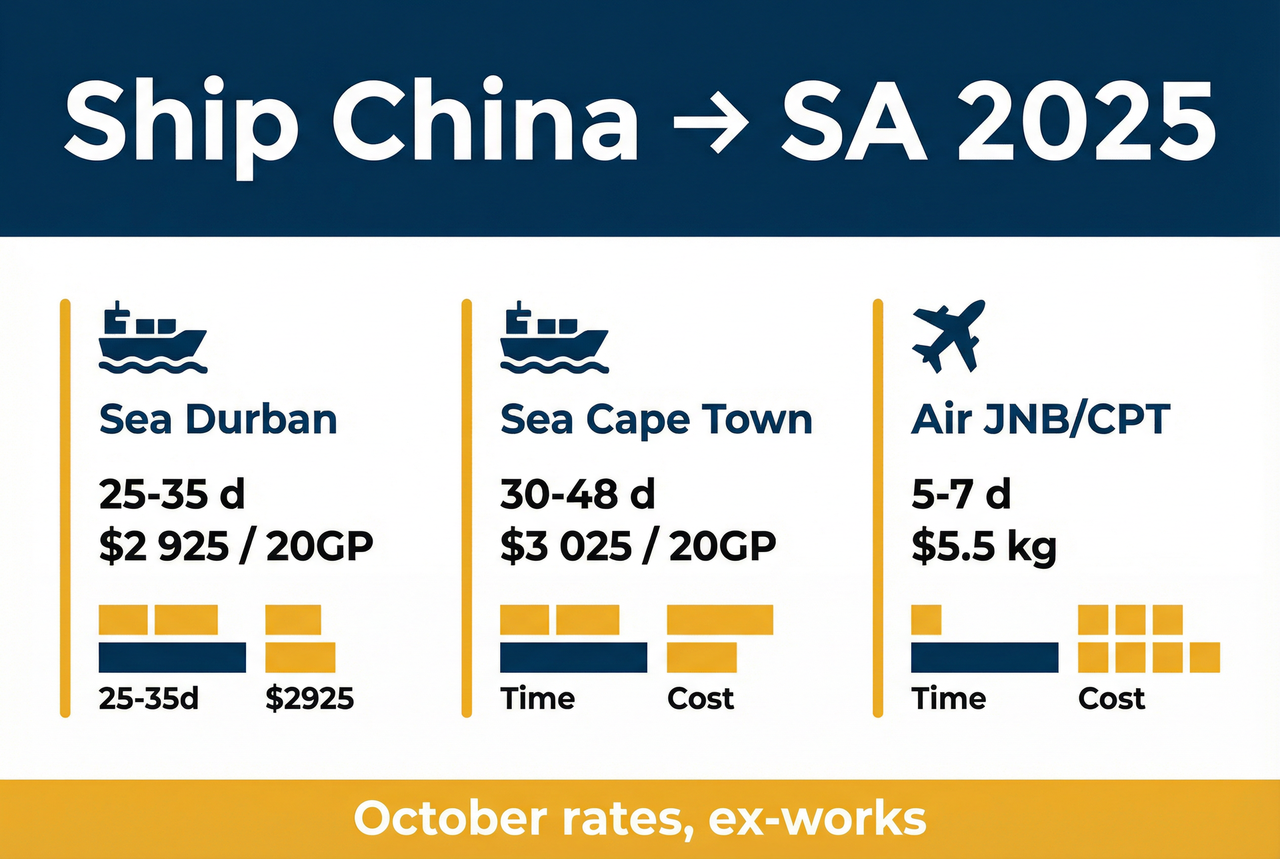
China-South Africa Shipping Routes: Transit times and cost comparison for major carriers (October 2024)
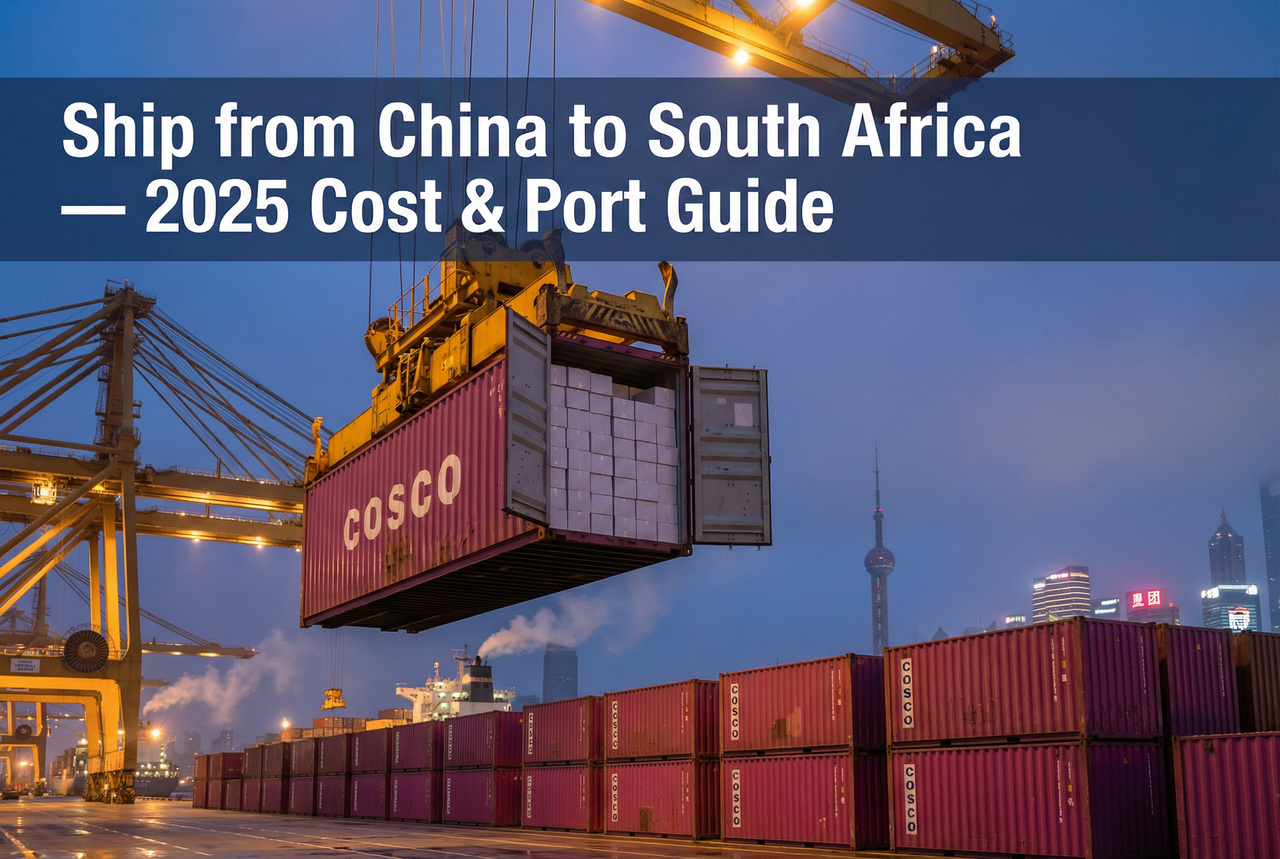
COSCO 40ft High Cube container operations at South African container terminal - modern port infrastructure handling China imports
Confused by South African Compliance?
PFC Express manages SARS customs declarations, duty calculations, and broker coordination for 2,000+ South Africa shipments annually.
Get South Africa Shipping QuoteSection 3: SARS Customs Clearance Process
SARS customs is bureaucratic, paper-heavy, and unforgiving of errors. Unlike the US or EU where minor doc issues cause delays, in South Africa they cause detention and storage fees (R500-2,000/day). Here's how to get it right:
Required Documents (No Exceptions)
🚨 Mandatory for ALL Shipments
- 1. Commercial Invoice (3 copies): Must show ZAR values (preferred) or USD with conversion rate. Include: Seller details, buyer details, HS codes (8-digit SA classification), quantities, unit prices, total CIF value.
- 2. Packing List: Detailed breakdown of packages, marks/numbers on boxes, weights (gross and net), dimensions, contents of each package.
- 3. Bill of Lading (sea) or Air Waybill: Original or telex release. Must match invoice details exactly (weights, packages, values).
- 4. SAD 500 Form: SARS Customs Declaration (Single Administrative Document). Usually filed by your customs broker, but you provide the data.
- 5. Tax Clearance Certificate: Required for commercial importers (not for personal/one-time shipments). Register with SARS and obtain tax clearance PIN.
Customs Broker Requirements
Unlike some countries where you can self-clear, South Africa effectively requires a licensed customs broker for commercial shipments (personal shipments Typical fees: What they do: Step 1: Establish CIF Value Step 2: Apply 10% Upliftment (SARS Rule) Step 3: Calculate Import Duty (5% for electronics) Step 4: Calculate VAT (15% on Customs Value + Duty) Total Taxes: R2,188 Total Landed Cost: R9,585 + R2,188 = R11,773 Markup from CIF: 23% If you're manufacturing in SADC member countries (14 nations in Southern African Development Community) or using them as trans-shipment points, you can access preferential duty rates or full exemptions: Angola, Botswana, Comoros, DRC, Eswatini, Lesotho, Madagascar, Malawi, Mauritius, Mozambique, Namibia, Seychelles, Tanzania, Zambia, Zimbabwe How it works: Let's compare actual costs for shipping 500 units of a product (50kg total, 3 CBM) from China to Johannesburg: PFC Express handles China-South Africa logistics end-to-end: SARS customs, duty calculations, and broker coordination. Most sellers look at South Africa's 45% clothing duty and 15% VAT and immediately write off the market. That's a mistake. South Africa remains Africa's most sophisticated e-commerce market, with established payment systems, reliable last-mile delivery (PostNet, The Courier Guy), and a growing middle class (8 million households earning >R20,000/month). The key is product selection. Fashion dropshipping is dead (67% markup makes you uncompetitive). But electronics, industrial supplies, and B2B goods with 20-33% total tax burden? Absolutely viable. The 2024 SARS changes effectively redirected the market away from ultra-cheap consumer goods toward higher-value, higher-margin products. Work with experienced South Africa logistics partners who understand SARS customs, have broker relationships in Durban/Cape Town, and can navigate the complexities. The sellers who succeed in South Africa are the ones who treat compliance as competitive advantage, not operational burden. 📞 Need South Africa Shipping Expertise? Our Shenzhen team has cleared 15,000+ South Africa shipments, partnered with licensed SARS brokers in Durban and Cape Town, and navigated every customs change since 2020. We offer: Contact PFC Express:🏢 Customs Broker Costs & Services
Calculating Duties & VAT (The 10% Upliftment Rule)
💰 Complete Duty Calculation Example
Example: R10,000 Electronics Shipment (Laptops, 5% Duty)
Duty Rates by Product Category
Product Category
Duty Rate
Total Tax Impact
Notes
Electronics (computers, phones)
0-10%
~20-33%
Most electronics: 5% duty
Clothing & Textiles
45%
~67%
Highest duty, targets Shein/Temu
Footwear
30%
~49%
High protection for local industry
Furniture
20%
~38%
Moderate protection
Automotive Parts
18-25%
~36-44%
Varies by part type
Processed Food
15-20%
~33-38%
Health permits required
Raw Materials
0-5%
~15-20%
Lowest duties to support manufacturing
Section 4: SADC Trade Benefits (Duty Reductions)
🌍 SADC Member Countries (Duty-Free Access)
Section 5: Common Pitfalls & How to Avoid Them
🚨 Top 5 Mistakes That Cause Detention
Section 6: Real-World Cost Comparison
Method
Transit
Freight
Duties (10%)
Clearance
Total
Per Unit
Express Air (DHL)
3-5 days
R10,500 (50kg×R210)
R5,250
R600
R16,350
R32.70
Standard Air
7-10 days
R6,300 (50kg×R126)
R5,250
R500
R12,050
R24.10
Sea LCL
30-35 days
R2,850 (3CBM×R950)
R5,250
R1,200
R9,300
R18.60
Sea FCL (20ft)
25-30 days
R28,500 (container)
R5,250
R1,500
R35,250
R3.53 (10k units)
Ready to Ship to South Africa?
Final Thoughts: South Africa as a Strategic Market
TAGS:
About Noel Murphy
Logistics Expert & Ecommerce Consultant